
Learning the primary ideas of mathematics can be easy and fun for students with the help of a GCSE Maths tutor. Using the correct learning style and technique can be a tool to help students transcend memorizing formulas. It starts to appreciate the rationale behind mathematical methods and the conditions under which they are applicable.
Mathematics and Scientific Thinking
There is a close linkage between science and mathematics. Many observations in science include measurements, calculations, graphs, statistics, and mathematical models.
Understanding Measurements
Distance, time, mass, temperature, speed, and volume are measured regularly by scientists. It is therefore imperative that students be confident in numbers and units before they can fully grasp many scientific concepts. Mathematics enables learners to compare measurements, convert from one unit to another, find out how measurements differ, and look at the relationships between quantities.
For instance, the concept of ratio and rate may be used to analyze scientific information. A student who appreciates the relationship of quantities is better equipped to interpret experiments and results.
Working With Data
In science, experiments are carried out, and data is collected that must be organized and interpreted. When learning science, students are likely to come across tables, graphs, averages, percentages, and other mathematical representations. The mathematics tools help them make sense of these various representations of information. Therefore, knowledge of how to read a graph, determine a trend and/or calculate an average may assist in the performance of multiple subjects.
YOU MAY ALSO READ: How Education is Science?
The Development of Problem-Solving Skills
See below:
Solving Complex Problems
Students can be taught how to break it down into sections. They may start by identifying the information given, what information is needed, a suitable method, and then see if the answer falls into the method. This process can be used in other areas besides Mathematics. Dividing up a challenging school task, scientific investigation, or a decision in the real world can help make it easier to handle.
Learning From Mistakes
Mathematical mistakes can provide useful learning opportunities. This helps students to see their errors as learning opportunities and not as errors. It is important to have this mindset as students grow.
Understanding is Better than Memorizing
While rote-learned facts are important in math, it is better to understand them in the long term.
Understanding the Rationale behind a Formula’s Operation
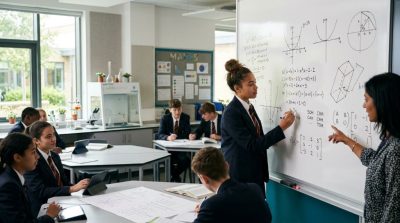 Students might know a formula for an exam without comprehending what it stands for. If the learners are aware of the relationship behind a formula, they will be confident in identifying situations in which the formula can be used. For instance, if students are aware of the connection between distance, speed, and time, they can better deal with various kinds of problems.
Utilizing knowledge in new problem solving is one way that mathematical comprehension is important rather than just knowing answers.
Mathematics in Everyday Decisions
There are contexts outside of school where mathematical skill is expressed.
Managing Money
When dealing with money, percentages and decimals, as well as addition, subtraction and simple financial calculations are helpful. Mathematics can be used to compare prices, work out discounts, make budgets, work out interest, and predict costs. These skills can instill confidence in students as they make financial choices later in their lives.
Knowing Time and Distance
Maths is also used in daily arrangements. Individuals make estimates of travel times, compare distances, make schedules, and determine the duration of activities. Simple mathematical reasoning can be applied in everyday planning to make it more efficient.
Mathematics and Technology
Mathematics is an integral part of modern technology. Mathematics is used in various ways in computers, engineering systems, in digital communication, in data analysis, in artificial intelligence, and many scientific applications. The mathematical confidence that is developed, therefore, may make it easier for students to grasp underlying mathematical concepts in technologies that they encounter.
Data Literacy
In the field of education and daily life, data is becoming more and more significant. Students are exposed to statistics in news reports, through websites, social media, research, and advertising. They can use the concepts of averages, percentages, graphs, and probability to make better-informed evaluations of information.
Logical Thinking
Mathematics promotes logical thinking as well. Students are taught how to identify relationships, follow rules, test solutions, and assess whether or not conclusions follow from information. These skills are applicable to computing, science, engineering, and a variety of other fields.
Supporting Different Learning Styles
All students are not mathematically alike. Some learn concepts easily by diagrams, others by written explanations or worked examples.
Visual Learning
Images such as graphs, number lines, diagrams, and geometric pictures can help to clarify abstract concepts. Students can use visual representations to help them recognize relationships that may not have been apparent from the equations.
Step-by-Step Learning
Solving a complete problem divided into manageable phases is also beneficial for other learners. Students may improve their independent problem-solving skills by understanding the importance of each step. This is more crucial than a simple presentation of the final answer.
Future Education and How to Prepare for It
Through the assistance of GCSE-level education, students may develop confidence in solving Math problems. A variety of academic and professional areas involve mathematical reasoning even when Math is just a complementary subject.
Conclusion
The most valuable mathematical lesson is not always the answer to a problem. It could be learning to approach a problem from different angles, to analyze in a systematic way, and to evaluate whether the end product is reasonable.