
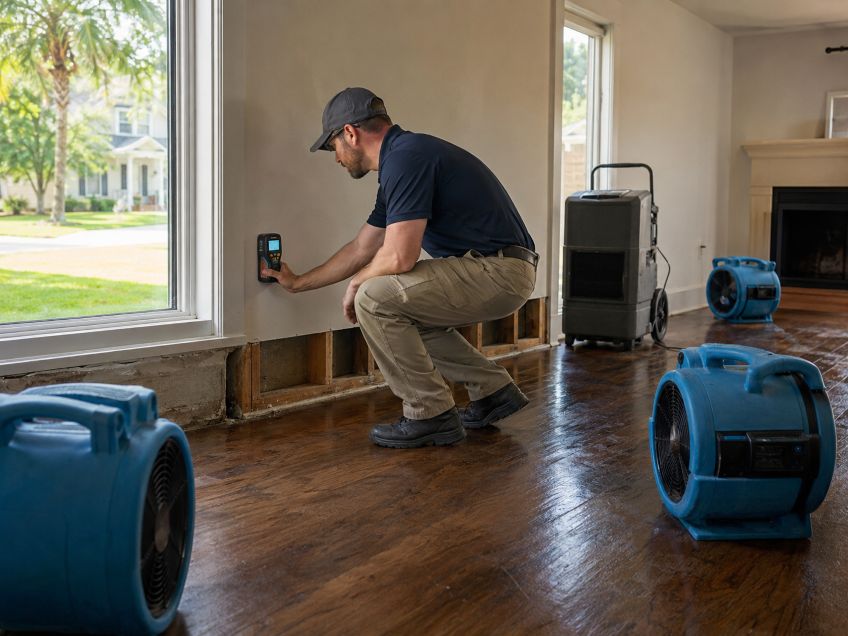
Standing water can disappear while a building is still holding moisture. Water can soak into drywall, wood, insulation, carpet backing, concrete, and subfloors. The U.S. Environmental Protection Agency warns that wet building materials should be dried quickly because prolonged dampness creates conditions where mold can grow. A floor that feels dry may therefore tell only part of the story.
That difference between visible dryness and actual dryness is why Georgia water damage restoration services may focus on moisture detection as much as water removal. The Georgia restoration site describes thermal imaging, moisture checks, industrial extraction, air movers, and dehumidification as parts of structural drying. Those methods matter because water often travels beyond the place where a leak or flood first appeared.
How Does Water Stay Hidden After the Puddle Is Gone?
Porous materials behave like sponges. They take in liquid through small spaces and can hold it below the surface. Water may also move through seams, wall cavities, and flooring layers. This movement is often described as moisture migration.
The U.S. Environmental Protection Agency notes that moisture can move from one part of a building into another through cracks and openings. It also explains that drywall, carpet, wood, and furnishings can stay wet after a flood. Removing standing water is only the first step.
Evaporation explains what happens next. Liquid water changes into water vapor and moves into the surrounding air. Drying becomes faster when the air can accept more moisture and moving air passes over wet surfaces.
Why Relative Humidity Changes the Drying Process
Relative humidity describes how much water vapor is in the air compared with how much the air could hold at the same temperature. High relative humidity can slow evaporation.
The U.S. Environmental Protection Agency recommends keeping indoor humidity below 60 percent when possible and says about 30 to 50 percent is generally preferable for moisture control. It also notes that warm, humid outdoor air can slow flood drying.
That point matters in Georgia. The National Weather Service describes north and central Georgia summers as long, warm, and humid. The University of Georgia also characterizes the state as having a humid subtropical climate. Opening windows can work against drying when outdoor air is humid.
Household Fans vs. Controlled Structural Drying
A household fan can help with a small spill on an exposed surface. It moves air across the material and supports evaporation. The limitation is that a fan does not remove moisture from the air. It may simply transfer water from a surface into an already humid room.
Controlled structural drying takes a broader approach. Commercial air movers create stronger, directed airflow across wet materials. Dehumidifiers pull water vapor from the air. Lower humidity gives more moisture inside the building a chance to evaporate.
The U.S. Environmental Protection Agency notes that commercial firms working on water-damaged buildings often use large fans, dehumidifiers, and other equipment to speed drying. Airflow and moisture removal work best as connected parts of the same drying process.
Where Surface Drying Falls Short
Appearance can be misleading. Paint may look normal while the back of drywall remains damp. Carpet can feel dry while the pad or subfloor underneath still holds water. Hardwood may also retain moisture below the finished face. Similar problems can occur with tile and grout because these materials can hold moisture and collect residue below or within the surface. Understanding how moisture affects porous surfaces can help explain why staining or discoloration may remain even after an area appears clean and dry.
The Centers for Disease Control and Prevention warns that mold can be hidden behind walls, under carpet, or inside other materials after flooding. It advises complete drying and removal of materials that cannot be cleaned and dried. The U.S. Environmental Protection Agency likewise stresses drying wet areas within roughly 24 to 48 hours when possible.
Moisture meters help answer a question that sight and touch cannot. The U.S. Environmental Protection Agency recommends using a moisture meter to judge whether walls, cabinets, and flooring are dry enough for refinishing. Thermal imaging can flag temperature patterns that deserve closer inspection, while direct moisture measurement helps confirm whether a material is still wet.
What Changes When Drying Is Measured?
A controlled drying plan is less about running equipment for a fixed number of days and more about tracking change. Technicians can record moisture readings in walls, floors, trim, and other affected materials. They can also monitor indoor temperature and relative humidity.
Repeated readings show whether moisture levels are falling. If one area stays wet while nearby materials improve, that may point to trapped water, limited airflow, insulation, or another condition needing attention. Equipment can then be repositioned or the drying plan adjusted.
The final question is not, “Does the room look dry?” It is, “Are the materials returning toward a verified dry condition?” Flood drying moves water from materials into the air, removes moisture from that air, and measures progress until an appropriate drying goal is reached. That evidence matters more than a surface that simply looks normal again.